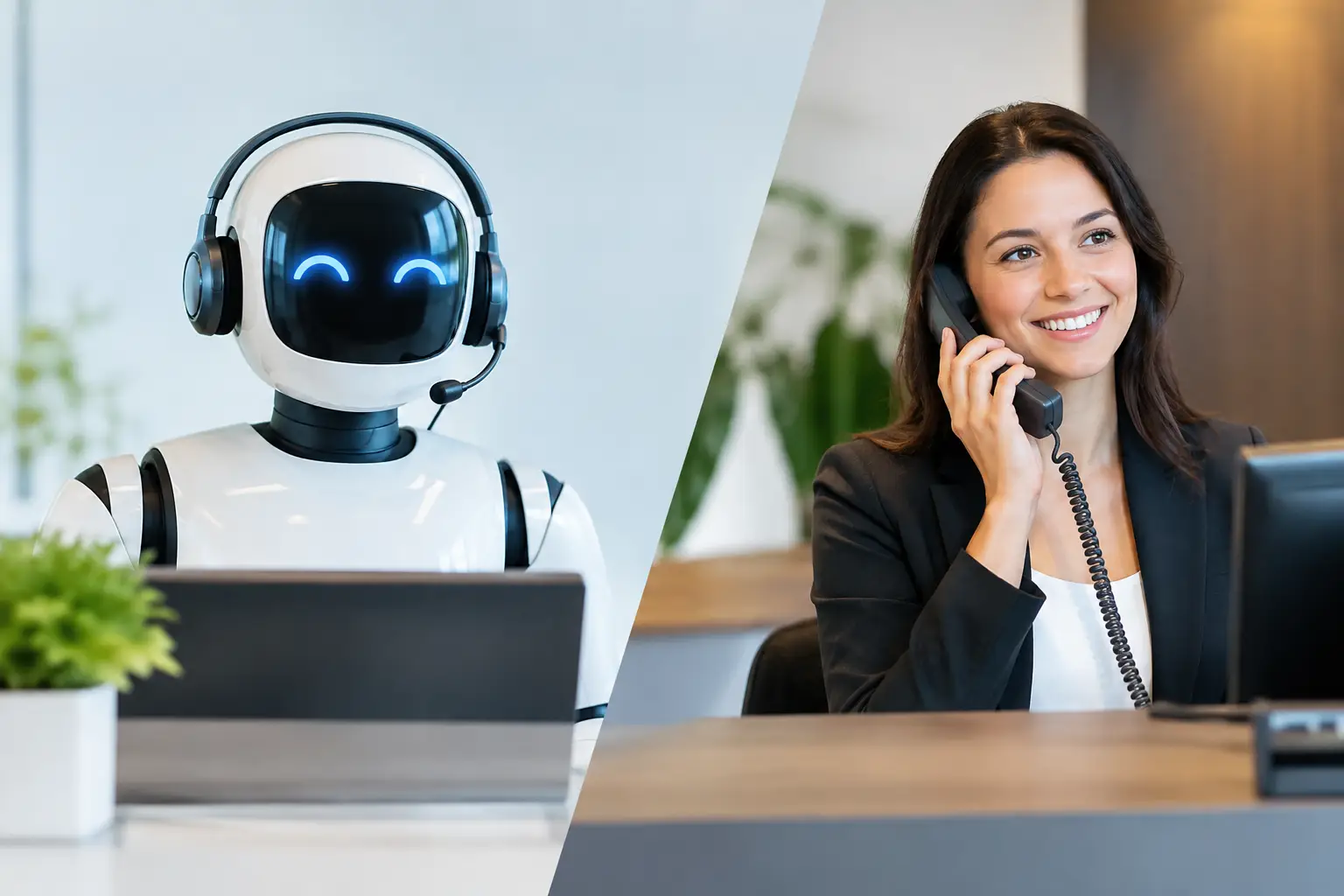
A caller with a burst pipe at 9:15 p.m. is not comparing staffing models. They want to know whether you can help, when someone can come out, and what happens next. That is where the AI receptionist versus virtual receptionist decision gets real. Both can stop calls from going to voicemail. But they handle speed, cost, consistency, and complex conversations very differently.
For a business that depends on booked jobs, policies sold, consultations scheduled, or qualified sales calls, the right answer is not whichever option sounds more modern. It is the one that gives good callers a clear path to the next step without creating more work for your team.
What an AI receptionist actually does
An AI receptionist is a voice agent that answers incoming calls, has a natural back-and-forth conversation, collects the details you need, and takes an action based on the call. That might mean booking an appointment directly on the calendar, routing an urgent call, answering common questions, or sending a clean call summary to your team.
The practical value is coverage. It can answer at 7:00 a.m. while the crew is loading trucks, at noon when everyone is busy, and at 10:30 p.m. when the office is closed. It does not need breaks, shift changes, or a caller to wait in a queue because another conversation ran long.
A good AI receptionist should not try to be clever. It should know your service area, business hours, job types, basic pricing rules if you choose to share them, and what counts as an emergency. It should ask the questions your dispatcher or office manager would ask, then book or route the call correctly.
The difference is action. A basic answering service may take a message. An AI receptionist can qualify the caller and put a real appointment on the calendar while the caller is still motivated.
What a virtual receptionist does
A virtual receptionist is a human who answers calls remotely. This can mean a dedicated remote receptionist, a shared team at an answering service, or an offshore or U.S.-based call center. The model varies widely, so business owners should ask exactly who answers, when they answer, and how much training they receive on the business.
A strong virtual receptionist brings human judgment. They can calm down an upset customer, recognize when someone is confused, and handle an unusual request that falls outside a script. For a law office dealing with sensitive personal details, a medical practice with complex intake, or a business with high-value jobs that require careful explanation, that judgment can matter.
The trade-off is capacity and consistency. A person can only handle one detailed call at a time. Shared receptionist teams may answer for many businesses. Even a well-trained person can miss a detail, forget an updated policy, or need a supervisor when a caller goes off script.
Virtual receptionists also tend to make the most sense during defined coverage windows. If you need every call answered around the clock, the cost and staffing complexity rise quickly.
AI receptionist versus virtual receptionist: the operational differences
The clearest way to compare the two is to look at what happens between the first ring and a booked job.
Call volume and answer speed
AI handles multiple simultaneous calls. If three people call after a hailstorm or a neighborhood power outage, each can be answered right away. That matters when demand spikes and callers are dialing several companies in a row.
A virtual receptionist can provide a warm human voice, but coverage depends on available staff. If the service is handling a rush, callers may be placed on hold or sent to voicemail. Ask for real data on average answer time, abandonment rate, and what happens when lines are busy.
Booking and follow-through
Both options can collect a name, number, and reason for the call. That is not the same as converting the call.
The better setup books the estimate, service window, or consultation before the caller hangs up. AI is especially effective when the scheduling rules are clear: service area, appointment types, available slots, emergency routing, and required intake questions. It performs those steps the same way on every call.
A virtual receptionist can book as well, but only if they have calendar access, current instructions, and enough training to make the right judgment. Otherwise, they take messages that your staff must chase later. Every handoff adds delay, and delay costs jobs.
Cost structure
A virtual receptionist usually has a base fee plus charges based on minutes, calls, after-hours coverage, or additional services. The headline rate may look reasonable until call volume grows or the service starts handling calls that should have been resolved with a fast booking flow.
AI receptionists are usually easier to scale because one agent can handle more calls without adding another person to the schedule. But do not buy based on a low software price alone. If you are expected to configure prompts, maintain phone numbers, troubleshoot calendar connections, and keep the agent current, you have simply traded payroll for another project.
For most owner-led businesses, the total cost is the monthly fee plus the management burden. A service that keeps the system healthy and improves it based on real calls can be worth more than a cheaper tool sitting half-finished.
The customer experience
Some owners worry that every caller will reject an AI voice. That is too broad. Callers usually care more about getting help quickly than about hearing a person say, “Let me take a message.” A clear, polite agent that understands the request and books the job can be a better experience than voicemail.
Still, there are situations where a human is the better choice. A customer disputing an invoice, an emotional insurance claimant, or a caller with a complicated commercial project may need a person. The answer is not to force every call through one channel. Set clear escalation rules so the AI can transfer those calls to the right human when one is available.
Training and control
A virtual receptionist needs onboarding, reference materials, coaching, and regular updates. When your pricing, service areas, or seasonal offers change, somebody must tell the team and confirm they are using the new information.
An AI receptionist also needs setup and updates, but the changes can be applied consistently across every call. The key is having someone accountable for reviewing call outcomes. If callers repeatedly ask a question the agent cannot answer, that is not a reason to give up on the system. It is a reason to add the answer or improve the routing rule.
When a virtual receptionist is the better fit
Choose a virtual receptionist when the calls demand frequent empathy, deep case-by-case judgment, or detailed explanations that cannot be reduced to a reliable workflow. A business with lower call volume but highly sensitive conversations may get more value from a trained human who knows the operation well.
It can also be a good bridge when your processes are still unclear. If nobody can explain how calls should be qualified, what information is needed, or who owns urgent requests, automation will expose that problem fast. Get the process straight first.
Just be honest about the goal. If the virtual receptionist is primarily taking messages because the office is too busy to answer, you have not solved the revenue leak. You have documented it.
When an AI receptionist is the better fit
AI is a strong fit when missed calls are common, the same questions come up every day, and a fast booking or qualification flow wins business. Home service companies, insurance agencies, sales teams, and appointment-driven businesses often fit this profile.
Picture a plumbing company. The caller says the water heater is leaking. The agent confirms the ZIP code, asks whether water is actively leaking, collects the address, offers the next available service window, and alerts the on-call technician if the situation is urgent. That is useful whether the call arrives during lunch, after closing, or while the office is already handling another customer.
Relay by Cactus AI is built around that kind of outcome: answer the call, qualify it, and book or transfer it without asking the owner to become a software administrator. The operating model matters as much as the voice agent. Someone needs to monitor call quality, keep the number working, and tune the flow as the business learns what converts.
A practical way to decide
Start with a week of real call data. Look at when calls arrive, how many are missed, how many lead to revenue, and how long it takes your team to call people back. Then ask four direct questions:
- Do callers mostly need a predictable next step, such as booking, pricing guidance, or basic qualification?
- Are missed calls happening outside business hours or while staff are already on the phone?
- Can you define clear rules for what should be booked, transferred, or treated as urgent?
- Do enough calls require sensitive judgment that a human needs to take them from the start?
If the first three answers are yes, an AI receptionist will likely recover more opportunities at a lower operating burden. If the fourth answer is yes for a large share of your calls, a virtual receptionist or a hybrid setup may be the smarter move.
A hybrid model is often the practical answer. Let AI cover first response, routine qualification, overflow, and after-hours booking. Route exceptions, escalations, and high-stakes calls to your team or a trained human receptionist. That gives customers a fast answer without pretending every conversation is identical.
The next missed call is a useful test. If your current process cannot tell that caller what happens next in under a minute, fix that before spending another dollar to generate more leads.